
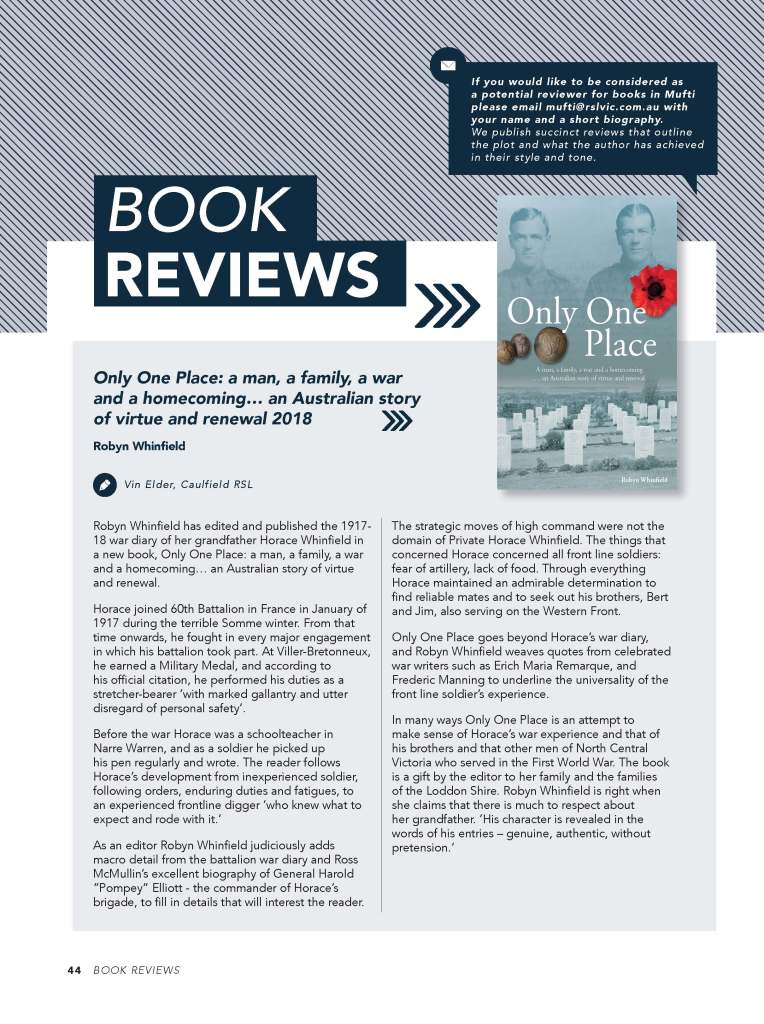
Book review by Vin Elder, Caulfield RSL, published in the RSL Victoria newsletter, Mufti.

Robyn Whinfield has edited and published the 1917-18 war diary of her grandfather Horace Whinfield in a new book, Only One Place: a man, a family, a war and a homecoming… an Australian story of virtue and renewal.

Horace joined 60th Battalion in France in January of 1917 during the terrible Somme winter. From that time onwards, he fought in every major engagement in which his battalion took part. At Viller-Bretonneux, he earned a Military Medal, and according to his official citation, he performed his duties as a stretcher-bearer ‘with marked gallantry and utter disregard of personal safety’.

Before the war Horace was a schoolteacher in Narre Warren, and as a soldier he picked up his pen regularly and wrote. The reader follows Horace’s development from inexperienced soldier, following orders, enduring duties and fatigues, to an experienced frontline digger ‘who knew what to expect and rode with it.’

As an editor Robyn Whinfield judiciously adds macro detail from the battalion war diary and Ross McMullin’s excellent biography of General Harold “Pompey” Elliott – the commander of Horace’s brigade, to fill in details that will interest the reader.

The strategic moves of high command were not the domain of Private Horace Whinfield. The things that concerned Horace concerned all front line soldiers: fear of artillery, lack of food. Through everything Horace maintained an admirable determination to find reliable mates and to seek out his brothers, Bert and Jim, also serving on the Western Front.

Only One Place goes beyond Horace’s war diary, and Robyn Whinfield weaves quotes from celebrated war writers such as Erich Maria Remarque, and Frederic Manning to underline the universality of the front line soldier’s experience.

In many ways Only One Place is an attempt to make sense of Horace’s war experience and that of his brothers and that other men of North Central Victoria who served in the First World War. The book is a gift by the editor to her family and the families of the Loddon Shire. Robyn Whinfield is right when she claims that there is much to respect about her grandfather. ‘His character is revealed in the words of his entries – genuine, authentic, without pretension.’

Mufti Magazine book review

Wendy Wong went to school with Robyn Whinfield at Kerang High School. Wendy made the following comments about her reading of Only One Place:

I’m really enjoying your book! I can relate to so many of the people mentioned and, of course, to the historical records …. Wow! The time you must have spent on research is unbelievable! This book has to win awards!

I’ve definitely found many things of interest. Wow! Your grandfather was a talented writer! It’s obvious where you inherited this talent! 

The research you have done for this book is amazing. I’m in awe! It’s so well written. It’s certainly renewed my interest in the history of WW1. I feel I never really focused much on this part of our history, despite all my years of studying history. I even taught history for a few years in my early teaching career but this was never part of the curriculum.

I have found many connections throughout the book. Many of the people and places mentioned are familiar to me. My eyes widened early in the book when I found one of the schools your grandfather was sent to, in his early days in teaching, was Cannie. (Page 19) That school, if it still existed when we started school, would have been our local school! It was only a few kilometres from our place!  My eyes widened further when I looked at the photo of your grandfather with the Kerang Shire Council 1950. I remember almost all those men. John Gorton looked young there!! And, JB Mann’s son lives just round the corner from us! Hopefully I’ll catch up with him soon to show him your book.

Wendy Wong

In the last few years a group of dedicated authors have published annotated transcriptions of diaries and letters of soldier who served in the First World War. In every case, these books have added a valuable contribution to our understanding of that war. They provide valuable material for researchers and for future generations.

Some of the transcriptions have been very good indeed – others much less so. This book is clearly in the first category.

It is always difficult for those without direct military experience to understand – indeed, translate – the experiences of the Great War. What do all those acronyms, abbreviations and slang terms mean? Is a brigade bigger than a battalion or company? What’s a troop? Is it an army or a regimental number? These issues and a legion of others can cause misinterpretations and difficulties. Then there’s geography. Where are all those places mentioned in the text? How can we show them on maps? Then there’s the question of context. Who is our soldier? Where was he born and raised and what do he do before enlistment? What happened during the gaps in diaries and correspondence? What was the larger result of battles he was engaged in at his level?

Perhaps the most important inclusions are an index and a list of references. These make a transcription so much more usable and useful to readers. The perception that some have that these items are difficult to achieve or even unnecessary is to be greatly regretted.

 ‘Proper’ publication is a must. The law requires deposit copies for national libraries and an ISBN (International Standard Book Number). There are good reasons for these requirements.

As you may gather, these characteristics make up my checklist for whether a book is good or otherwise. Robyn Whinfield’s book meets all my criteria. In telling Horace’s story in 1917-1918 as a soldier in the 60th Battalion she has done us all a great service. Buy a copy when you have a chance!

Mike O’Brien CSC, Friends of the 15th Brigade Newsletter